
Will Lambeth finally do something about a Grade II listed school that’s been derelict for 13 years?
The opaque cogs of Lambeth Council's internal bureaucracy grind slowly on, as campaigners say the building needs a champion within the council

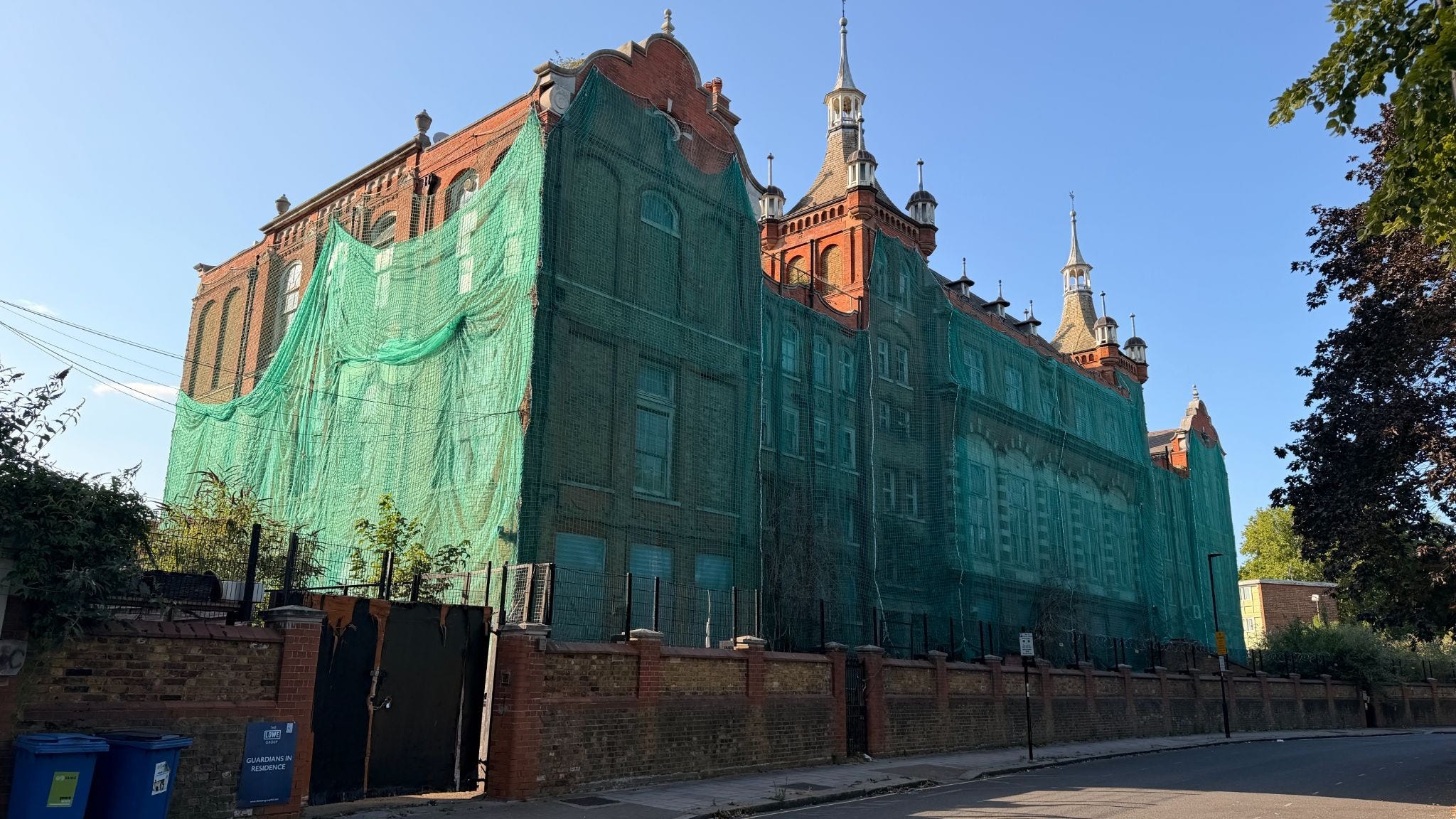
The former Charles Edward Brooke School on Cormont Road has been derelict since 2012, and was taken back under Lambeth Council’s control in 2021.
I wrote about the ongoing situation at the school last December for Brixton Buzz, and while there is some hope that the new Green-controlled council will be able to push things forward, the building still appears to be caught in a cycle of neverending bureaucracy.
In early July, Green cabinet members Scott Ainslie, Pete Elliot, and Myatt’s ward councillor Patience Clague went on a site visit with Lambeth staff, Save Cormont Road School campaigner Seb Frichot and Tracey Gregory, a local heritage campaigner. Fiona McKeith, Assistant Director of Valuation and Strategic Assets at the council also attended
Gregory told me that it “was good to get inside the school. Only got into the ground floor. Some water damage, but art works from the kids still on the wall look like they only left yesterday.”

Lambeth council is in the process of putting the school on the market for potential developers to bid for it. This requires certain procedural boxes to be ticked, such as having Council committees sign off on it. Unfortunately, the Council has significant internal capacity issues, with not enough staff and little real urgency to get something done with the building.
In the past, despite previous councillors for the area saying they have applied pressure to move the project on, there has been a lack of enthusiasm within the Council for putting the future of the building on the agenda, and too many competing priorities (housing, lack of money) for councillors and officers to make a final decision.
As for the sale itself, it is understood that the soft market testing of the site has now been completed. This early, informal stage is not the sale itself, but the way in which the council can take the temperature of the market before committing: who might be interested, what they would want to do with a building like this, what they could realistically afford, and what conditions would make a bid worth their while.
What comes back then feeds directly into how the formal opportunity is written and, crucially, into the parameters against which bidders will later be judged. In other words, the decisions that will most shape the outcome are being taken now, quietly, before anyone has formally bid on anything.
Under considerable pressure from campaigners, this soft marketing process was widened to reach as many potential bidders as possible. The formal marketing of the site is expected to launch in September, with a decision to follow. As I mentioned in my previous Brixton Buzz article, there has been one local art school interested in the site for the past two years, but there are fears that the process has now taken so long that they could end up moving out of the borough entirely.
To date, however, the council has seemed fixated on housing as the answer for the site. Seb Frichot says that “the council appear to be wedded to the idea of delivering luxury flats to the community”.


The problem is that housing in the main building simply doesn’t stack up. The school’s large rooms would need to be subdivided, and the expense of doing this in a Grade II listed building would prohibit anything other than luxury flats being built - something that is neither needed nor wanted, except perhaps by developers.
Campaigners are instead asking for a mixed-use site. It is understood that at least one potential bidder would deliver exactly that, possibly returning the main building to an educational use, with housing then developed on the remaining land. The site could also accommodate any number of uses other than luxury flats, and so it is hoped councillors will remain open-minded.
The really important question now is the process by which councillors will make their selection. What are the criteria against which bidders will be scored, and how will they be weighted? Local campaigners argue that this process should be debated, fully documented and transparent.
Whatever decision is made, the sale still has to be signed off by Lambeth’s new cabinet. Below you can see a drone-shot video of the back and roof of the building.
It seems clear that a lack of local reporting or public communicaion by the council about the fate of the school has contributed to a lack of urgency among the council and officers to move anything forward, so I think there remains a strong public interest in reporting the ongoing situation of the building and what may happen to it.
Both Seb Frichot and Tracey Gregory agree that the school needs someone in the council to champion its renovation.
A mixed use of the main building on the site would be the quickest route to returning the building to the community. An educational or institutional occupier could take the building broadly as it stands, using the large rooms as they were designed to be used. That means no wholesale subdivision, no drawn-out fight over listed building consent, no viability appraisal that only works if the flats are expensive enough. And no developer wriggling out of commitments to deliver affordable housing, as they are so prone to do.
With an educational or institutional occupier, campaigners say affordable housing could then be delivered on the grounds of the site, which would be more economically viable. It is hoped that Lambeth’s officers realise that a mixed use, such as this, could be the best solution for the site.
Further delays further risk the future of the building. Derelict buildings in this city rarely just decay quietly: they attract the sort of attention that ends with a fire and a cleared site, which has a way of resolving a heritage question that nobody in the town hall was willing to resolve themselves.
They may not have got to this important project yet but our new council is making progress on bringing properties back into use for the community. I was delighted to see yesterday that a small council house on a street near me is at last tenanted. It had been boarded up for 6 years and it was so lovely to see the windows un-blinded by ugly metal covers and a cheerful and friendly resident tending the little front garden. I calculated that even if rental for that home was as low as £200/week the loss of income through rental to the council will have been £60,000 while it stood forlorn and empty. Think of how many repairs to other homes that could have paid for and how many other £60,000s could have then been been saved. Lovely to have hope spiraling up instead of homelessness!